Personal JRubyArt blog
Monkstone
Ruby-Processing group blog
Ruby Processing Group
# fraction_sums.rb, by Martin Prout
attr_reader :f, :two, :three, :four, :five, :six

def setup
  sketch_title 'Math Blackboard'
  @f = createFont('Arial', 24, true)
  half = 1 / 2r     # since ruby 2.1.0 (and jruby-9.0.0.0)
  third = 1 / 3r
  quarter = 1 / 4r
  fifth = 1 / 5r
  sixth = 1 / 6r
  seventh = 1 / 7r
  format2 = '%s + %s                                     = %s'
  format3 = '%s + %s + %s                            = %s'
  format4 = '%s + %s + %s + %s                   = %s'
  format5 = '%s + %s + %s + %s + %s          = %s'
  format6 = '%s + %s + %s + %s + %s + %s = %s'
  sum2 =  half + third
  result2 = numeric_to_mixed_number(sum2)
  @two = format(format2, half, third, result2)
  sum3 =  half + third + quarter
  result3 = numeric_to_mixed_number(sum3)
  @three = format(format3, half, third, quarter, result3)
  sum4 =  half + third + quarter + fifth
  result4 = numeric_to_mixed_number(sum4)
  @four = format(format4, half, third, quarter, fifth, result4)
  sum5 =  half + third + quarter + fifth + sixth
  result5 = numeric_to_mixed_number(sum5)
  @five = format(format5, half, third, quarter, fifth, sixth, result5)
  sum6 =  half + third + quarter + fifth + sixth + seventh
  result6 = numeric_to_mixed_number(sum6)
  @six = format(format6, half, third, quarter, fifth, sixth, seventh, result6)
end

def draw
  background 10
  text_font(f, 24)
  fill(220)
  text('Math Blackboard JRubyArt', 110, 50)
  text(two, 100, 80)
  text(three, 100, 105)
  text(four, 100, 130)
  text(five, 100, 155)
  text(six, 100, 180)
end

def numeric_to_mixed_number(amount)
  amount_as_integer = amount.to_i
  if (amount_as_integer != amount.to_f) && (amount_as_integer > 0)
    fraction = amount - amount_as_integer
    format('%s %s', amount_as_integer, fraction)
  else
    amount.to_s
  end
end

def settings
  size 640, 250
  smooth 4
end

# ruby-processing sketch
# http://qiita.com/norioc/items/99514cb659aad03ab7d7
# http://aidiary.hatenablog.com/entry/20050402/1251514618
N = 15
attr_reader :rows, :cols

def setup
  sketch_title 'Bresenham`s Algorithm'
  @rows = height / N
  @cols = width / N
end

def settings
  size 400, 400
end

def build_line(from:, to:)
  next_x = from.x
  next_y = from.y
  delta_x = to.x - from.x
  delta_y = to.y - from.y
  step_x = delta_x < 0 ? -1 : 1
  step_y = delta_y < 0 ? -1 : 1
  delta_x = (delta_x * 2).abs
  delta_y = (delta_y * 2).abs
  b_line = Array.new(1, Vec2D.new(next_x, next_y))
  if delta_x > delta_y
    fraction = delta_y - delta_x / 2
    while next_x != to.x
      if fraction >= 0
        next_y += step_y
        fraction -= delta_x
      end
      next_x += step_x
      fraction += delta_y
      b_line << Vec2D.new(next_x, next_y)
    end
  else
    fraction = delta_x - delta_y / 2
    while next_y != to.y
      if fraction >= 0
        next_x += step_x
        fraction -= delta_y
      end
      next_y += step_y
      fraction += delta_x
      b_line << Vec2D.new(next_x, next_y)
    end
  end
  b_line
end

def draw
  background 255
  translate width / 2, height / 2
  rect_mode CENTER
  no_fill
  stroke 60
  (0..rows).each do |i|
    (0..cols).each do |j|
      rect((j - cols / 2) * N, (i - rows / 2) * N, N, N)
    end
  end
  x = mouse_x - width / 2 + N / 2
  y = mouse_y - height / 2 + N / 2
  b_line = build_line(from: Vec2D.new, to: Vec2D.new(x / N, y / N))
  unless b_line.empty?
    fill color('#C7B097')
    b_line.each { |v| rect(v.x * N, v.y * N, N, N) }
  end
  stroke color('#0000FF')
  stroke_width 2
  line 0, 0, mouse_x - width / 2, mouse_y - height / 2
  stroke 0
  stroke_width 1
end
def settings
  size(400, 400)
end

def setup
  sketch_title 'Resizable Surface'
  surface.set_resizable(true)
end

def draw
  background(255)
  stroke_weight 4
  line(100, 100, width - 100, height - 100)
end

def key_pressed
  surface.set_size(rand(200..500).floor, rand(200..500).floor)
end
def settings
  size(400, 400)
end

def setup
  sketch_title 'Resizable Surface'
  resizable(true)
end

def draw
  background(255)
  stroke_weight 4
  line(100, 100, width - 100, height - 100)
end

def key_pressed
  sketch_size(rand(200..500).floor, rand(200..500).floor)
end
OK a bit more experimentation also works with FX2D, blows up with P2D, but that's the same with vanilla processing (threading error).
# Earth model with bump mapping, specular texture and dynamic cloud layer.
# Adapted from the THREE.js tutorial to processing by Andres Colubri,
# translated to JRubyArt by Martin Prout:
# http://learningthreejs.com/blog/2013/09/16/how-to-make-the-earth-in-webgl/

attr_reader :earth, :clouds, :earth_shader, :cloud_shader, :earth_rotation
attr_reader :clouds_rotation, :target_angle

def setup
  sketch_title 'Blue Marble'
  @earth_rotation = 0
  @clouds_rotation = 0
  earth_tex = load_image('earthmap1k.jpg')
  cloud_tex = load_image('earthcloudmap.jpg')
  alpha_tex = load_image('earthcloudmaptrans.jpg')
  bump_map = load_image('earthbump1k.jpg')
  spec_map = load_image('earthspec1k.jpg')
  @earth_shader = load_shader('EarthFrag.glsl', 'EarthVert.glsl')
  earth_shader.set('texMap', earth_tex)
  earth_shader.set('bumpMap', bump_map)
  earth_shader.set('specularMap', spec_map)
  earth_shader.set('bumpScale', 0.05)
  @cloud_shader = load_shader('CloudFrag.glsl', 'CloudVert.glsl')
  cloud_shader.set('texMap', cloud_tex)
  cloud_shader.set('alphaMap', alpha_tex)
  @earth = create_shape(SPHERE, 200)
  earth.setStroke(false)
  earth.setSpecular(color(125))
  earth.setShininess(10)
  @clouds = create_shape(SPHERE, 201)
  clouds.setStroke(false)
end

def draw
  background(0)
  translate(width / 2, height / 2)
  point_light(255, 255, 255, 300, 0, 500)
  target_angle = map1d(mouse_x, (0..width), (0..TWO_PI))
  @earth_rotation += 0.05 * (target_angle - earth_rotation)
  shader(earth_shader)
  push_matrix
  rotate_y(earth_rotation)
  shape(earth)
  pop_matrix
  shader(cloud_shader)
  push_matrix
  rotate_y(earth_rotation + clouds_rotation)
  shape(clouds)
  pop_matrix
  @clouds_rotation += 0.001
end

def settings
  size(600, 600, P3D)
end
// Java seven

public static void createVec2(final Ruby runtime) {
    RubyClass vec2Cls = runtime.defineClass("Vec2D", runtime.getObject(), new ObjectAllocator() {
            @Override
            public IRubyObject allocate(Ruby runtime, RubyClass rubyClass) {
                return new Vec2(runtime, rubyClass);
            }
    });
    vec2Cls.defineAnnotatedMethods(Vec2.class);

}

// Java eight
public static void createVec2(final Ruby runtime) {
    RubyClass vec2Cls = runtime.defineClass("Vec2D", runtime.getObject(), (Ruby runtime1, RubyClass rubyClass) -> new Vec2(runtime1, rubyClass));
    vec2Cls.defineAnnotatedMethods(Vec2.class);
}
Update 22 August 2015 just released JRubyArt 0.5.0 featuring java8lambda in production...
# Axis aligned bounding box class (AABB would clash with Toxicgem)
class AaBb
  attr_reader :center, :extent

  def initialize(center:, extent:)
    @center = center
    @extent = extent
  end

  def self.from_min_max(min:, max:)
    new(center: (min + max) * 0.5, extent: max - min)
  end

  def position(vec)
    return @center = vec unless block_given?
    @center = vec if yield
  end

  def scale(d)
    @extent *= d
  end

  def contains?(vec)
    rad = extent * 0.5
    return false unless (center.x - rad.x..center.x + rad.x).cover? vec.x
    (center.y - rad.y..center.y + rad.y).cover? vec.y
  end
end
# Click on the box and drag it across the screen.

attr_reader :block, :block_locked, :over_block, :renderer, :bounds
BLOCK_WIDTH = 150

def setup
  sketch_title 'AaBb Example'
  @block = Block.new(
    center: Vec2D.new(width / 2, height / 2),
    size: Vec2D.new(BLOCK_WIDTH, BLOCK_WIDTH))
  @locked = false
  @over_block = false
  @bounds = AaBb.new(
    center: Vec2D.new(width / 2, height / 2),
    extent: Vec2D.new(width - BLOCK_WIDTH, height - BLOCK_WIDTH))
  @renderer = AppRender.new(self)
end

def draw
  background 0
  fill 153
  if block.over?(Vec2D.new(mouse_x, mouse_y))
    @over_block = true
    stroke 255
    fill 255 if block_locked?
  else
    @over_block = false
    stroke 153
  end
  # Draw the box as a shape
  begin_shape
  block.points_array.each { |vec| vec.to_vertex(renderer) }
  end_shape(CLOSE)
end

def block_locked?
  block_locked
end

def over_block?
  over_block
end

def mouse_pressed
  if over_block?
    @block_locked = true
    fill 255
  else
    @block_locked = false
  end
end

def mouse_dragged
  return unless block_locked?
  position = Vec2D.new(mouse_x, mouse_y)
  block.new_position(position) { bounds.contains? position }
end

def mouse_released
  @block_locked = false
end

def settings
  size 640, 360
  smooth 4
end

# Use class to contain block behaviour
class Block
  attr_reader :aabb

  def initialize(center:, size:)
    @aabb = AaBb.new(center: center, extent: size)
  end

  def new_position(center, &block)
    @aabb.position(center.dup, &block)
  end

  def over?(vec)
    aabb.contains? vec
  end

  # use for shape
  def points_array
    a = aabb.center - aabb.extent * 0.5
    c = aabb.center + aabb.extent * 0.5
    b = Vec2D.new(c.x, a.y)
    d = Vec2D.new(a.x, c.y)
    [a, b, c, d]
  end

  # use for rect
  def points
    [aabb.center, aabb.extent]
  end
end
# We extend the language of conditionals by adding the
# keyword "elsif". This allows conditionals to ask
# two or more sequential questions, each with a different
# action.

def setup
  background 0
  2.step(by: 2, to: width - 2) do |i|
    # If 'i' divides by 20 with no remainder
    # draw the first line..
    # else if 'i' divides by 10 with no remainder
    # draw second line, else draw third line
    if (i % 20) == 0
      stroke 255
      line i, 80, i, height / 2
    elsif (i % 10) == 0
      stroke 153
      line i, 20, i, 180
    else
      stroke 102
      line i, height / 2, i, height - 20
    end
  end
end

def settings
  size 640, 360
end

# An pry shell for live coding.
# Will start with your sketch.

require_relative 'base'
Processing.load_and_run_sketch

ARGV.clear # So that pry doesn't try to load them as files.

require 'pry'
$app.pry
class Fred < Processing::App
  def setup
    sketch_title 'Fred'
  end

  def draw

  end

  def settings
    size 300, 300, FX2D
    # smooth # here
  end
end

# experimental ArcBall class
class ArcBall
  attr_reader :applet, :x, :y, :r
  def initialize(app:, center_x: nil, center_y: nil, radius: nil)
    @applet = app
    @x = (center_x.nil?) ? app.width * 0.5 : center_x
    @y = (center_y.nil?) ? app.height * 0.5 : center_y
    @r = (radius.nil?) ? app.width * 0.8 : radius
  end

  def to_s
    format('ArcBall.new(applet: %s, centre_x: %d, centre_y: %d, radius: %d)',
           applet, x, y, r)
  end
end

Applet = Struct.new(:width, :height) do
  def to_s
    'MyApplet'
  end
end

applet = Applet.new(800, 600)
puts ArcBall.new(app: applet).to_s
puts ArcBall.new(app: applet, center_x: 300, center_y: 200, radius: 800).to_s
ArcBall.new(applet: MyApplet, centre_x: 400, centre_y: 300, radius: 640)
ArcBall.new(applet: MyApplet, centre_x: 300, centre_y: 200, radius: 800)
load_library :arcball

def setup
  sketch_title 'Arcball Box'
  ArcBall.new(app: self)
  fill 180
end

def draw
  background 50
  box 300, 300, 300
end

def settings
  size 600, 600, P3D
  smooth 8
end

# experimental ArcBall class
class ArcBall
  include_package 'arcball'
  attr_reader :applet, :x, :y, :r
  def initialize(app:, center_x: nil, center_y: nil, radius: nil)
    @applet = app
    @x = (center_x.nil?) ? app.width * 0.5 : center_x
    @y = (center_y.nil?) ? app.height * 0.5 : center_y
    @r = (radius.nil?) ? app.width * 0.8 : radius
    app = JarcBall.new applet.to_java, x.to_java(:float), y.to_java(:float), r.to_java(:float)
    app.set_active true
  end

  def to_s
    format('ArcBall.new(applet: %s, centre_x: %d, centre_y: %d, radius: %d)',
           applet, x, y, r)
  end
end
load_library :hemesh

# Module used to include java packages
module MS
  include_package 'wblut.math'
  include_package 'wblut.processing'
  include_package 'wblut.hemesh'
  include_package 'wblut.geom'
end

NUM = 50
attr_reader :mesh, :render, :points

def setup
  sketch_title 'Sponge'
  ArcBall.init(self)
  create_mesh
  @render = MS::WB_Render3D.new(self)
end

def draw
  background(255)
  directional_light(255, 255, 255, 1, 1, -1)
  directional_light(127, 127, 127, -1, -1, 1)
  stroke(0)
  render.draw_edges(mesh)
  no_stroke
  render.draw_faces(mesh)
end

def mouse_pressed
  create_mesh
end

def create_mesh
  rs = MS::WB_RandomOnSphere.new
  creator = MS::HEC_ConvexHull.new
  @points = (0..NUM).map { rs.next_point.mul_self(300.0) }
  creator.set_points(points)
  creator.setN(NUM)
  @mesh = MS::HE_Mesh.new(creator)
  @mesh = MS::HE_Mesh.new(MS::HEC_Dual.new(mesh))
  ext = MS::HEM_Extrude.new.set_chamfer(25).set_relative(false)
  mesh.modify(ext)
  sel = ext.extruded
  ext = MS::HEM_Extrude.new.set_distance(-40)
  mesh.modify_selected(ext, sel)
  mesh.smooth(2)
end

def settings
  size(800, 800, P3D)
  smooth(8)
end
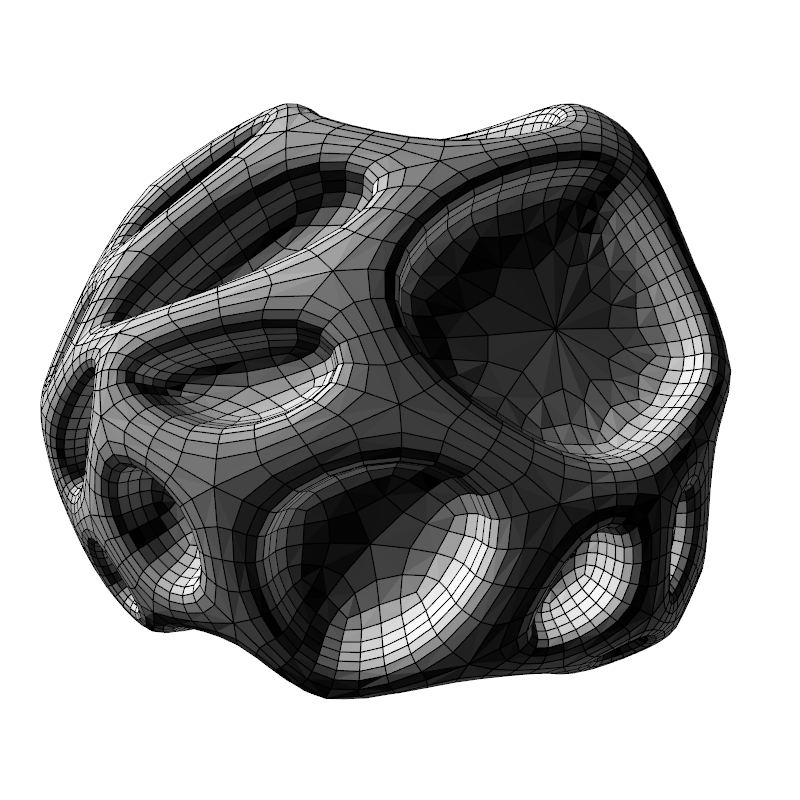
jruby -Djava.library.path="/home/tux/lib/linux64" trefoil.rbI needed to change the build to include the lwjgl jars and app.rb to accommodate the changes to processing but also unlike vanilla processing the sketch was also modified, replacing the applet convention of size(width, height, renderer) in setup with 3 methods (not required to be called in setup):-
# Old
  def setup
    size(1024, 768, P3D)
  end
#New
  def sketch_width
    1024
  end

  def sketch_height
    768
  end

  def sketch_renderer
    P3D
  end
def setup
  @num_chars = 26
  @key_scale = 200.0 / @num_chars - 1.0
  @rect_width = width / 4
  no_stroke
  background 0
end

def draw
  return unless key_pressed? && ('A'..'z').include?(key)
  key_index = key.ord - (key <= 'Z' ? 'A'.ord : 'a'.ord)
  fill millis % 255
  begin_rect = map1d(key_index, (0..25), (0..width - @rect_width))
  rect begin_rect, 0, @rect_width, height
end

def sketch_width; 640; end

def sketch_height; 360; end

def sketch_renderer; JAVA2D; end
require 'jruby_art'
require 'toxiclibs'
require_relative 'cluster'
require_relative 'node'

#
# Copyright (c) 2010 Daniel Shiffman
#
# This demo & library is free software you can redistribute it and/or
# modify it under the terms of the GNU Lesser General Public
# License as published by the Free Software Foundation either
# version 2.1 of the License, or (at your option) any later version.
#
# http://creativecommons.org/licenses/LGPL/2.1/
#
# This library is distributed in the hope that it will be useful,
# but WITHOUT ANY WARRANTY without even the implied warranty of
# MERCHANTABILITY or FITNESS FOR A PARTICULAR PURPOSE.  See the GNU
# Lesser General Public License for more details.
#
# You should have received a copy of the GNU Lesser General Public
# License along with this library if not, write to the Free Software
# Foundation, Inc., 51 Franklin St, Fifth Floor, Boston, MA  02110-1301  USA
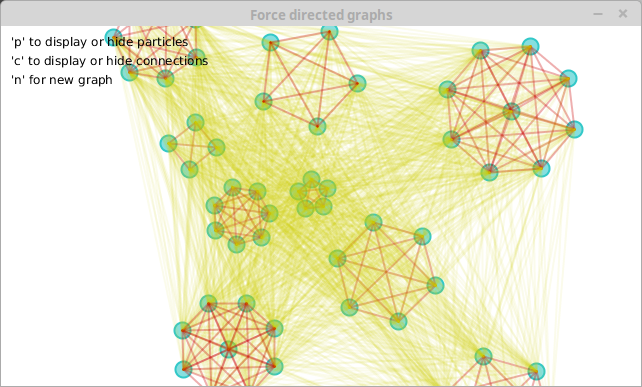
class ForceDirectedGraph < Processing::App
  attr_reader :physics, :clusters, :show_physics, :show_particles, :f

  def setup
    size(640, 360)
    @f = create_font('Georgia', 12, true)
    @show_physics = true
    @show_particles = true
    # Initialize the physics
    @physics = Physics::VerletPhysics2D.new
    physics.set_world_bounds(Toxi::Rect.new(10, 10, width - 20, height - 20))
    # Spawn a new random graph
    new_graph
  end

  # Spawn a new random graph
  def new_graph
    # Clear physics
    physics.clear
    center = TVec2D.new(width / 2, height / 2)
    @clusters = (0..8).map { Cluster.new(physics, rand(3..8), rand(20..100), center) }
    # All clusters connect to all clusters
    clusters.each_with_index do |ci, i|
      clusters[i + 1..clusters.size - 1].each do |cj|
        ci.connect(cj)
      end
    end
  end

  def draw
    # Update the physics world
    physics.update
    background(255)
    # Display all points
    clusters.each(&:display) if show_particles
    # If we want to see the physics
    if show_physics
      clusters.each_with_index do |ci, i|
        ci.internal_connections self
        # Cluster connections to other clusters
        clusters[1 + i..clusters.size - 1].each do |cj|
          ci.show_connections(self, cj)
        end
      end
    end
    # Instructions
    fill(0)
    text_font(f)
    text("'p' to display or hide particles\n'c' to display or hide connections\n'n' for new graph", 10, 20)
  end

  # Key press commands
  def key_pressed
    case key
    when 'c'
      @show_physics = !show_physics
      @show_particles = true unless show_physics
    when 'p'
      @show_particles = !show_particles
      @show_physics = true unless show_particles
    when 'n'
      new_graph
    end
  end
end

ForceDirectedGraph.new(title: 'Force directed graphs')
cluster.rb
#
# Copyright (c) 2010 Daniel Shiffman
#
# This demo & library is free software you can redistribute it and/or
# modify it under the terms of the GNU Lesser General Public
# License as published by the Free Software Foundation either
# version 2.1 of the License, or (at your option) any later version.
#
# http://creativecommons.org/licenses/LGPL/2.1/
#
# This library is distributed in the hope that it will be useful,
# but WITHOUT ANY WARRANTY without even the implied warranty of
# MERCHANTABILITY or FITNESS FOR A PARTICULAR PURPOSE.  See the GNU
# Lesser General Public License for more details.
#
# You should have received a copy of the GNU Lesser General Public
# License along with this library if not, write to the Free Software
# Foundation, Inc., 51 Franklin St, Fifth Floor, Boston, MA  02110-1301  USA
class Cluster
  attr_reader :nodes, :diameter, :physics

  # We initialize a with a number of nodes, a diameter, and centerpoint
  def initialize(physics, n, d, center)
    @physics = physics
    @diameter = d
    @nodes = (0..n).map { Node.new(center.add(TVec2D.random_vector)) }
    # Connect all the nodes with a Spring
    nodes[1..nodes.size - 1].each_with_index do |pi, i|
      nodes[0..i].each do |pj|
        physics.add_spring(Physics::VerletSpring2D.new(pi, pj, diameter, 0.01))
      end
    end
  end

  def display
    nodes.each(&:display)
  end
  # This functons connects one cluster to another
  # Each point of one cluster connects to each point of the other cluster
  # The connection is a "VerletMinDistanceSpring"
  # A VerletMinDistanceSpring is a spring which only enforces its rest length if the
  # current distance is less than its rest length. This is handy if you just want to
  # ensure objects are at least a certain distance from each other, but don't
  # care if it's bigger than the enforced minimum.

  def connect(other)
    other_nodes = other.nodes
    nodes.each do |pi|
      other_nodes.each do |pj|
        physics.add_spring(Physics::VerletMinDistanceSpring2D.new(pi, pj, (diameter + other.diameter) * 0.5, 0.05))
      end
    end
  end

  # Draw all the internal connections
  def internal_connections(app)
    app.stroke(200, 0, 0, 80)
    nodes[0..nodes.size - 1].each_with_index do |pi, i|
      nodes[i + 1..nodes.size - 1].each do |pj|
        app.line(pi.x, pi.y, pj.x, pj.y)
      end
    end
  end

  # Draw all the connections between this and another Cluster
  def show_connections(app, other)
    app.stroke(200, 200, 0, 20)
    app.stroke_weight(2)
    other_nodes = other.nodes
    nodes.each do |pi|
      other_nodes[0..other_nodes.size - 1].each do |pj|
        app.line(pi.x, pi.y, pj.x, pj.y)
      end
    end
  end
end
require 'forwardable'

# The Nature of Code
# Daniel Shiffman
# http://natureofcode.com
# Force directed graph
# Heavily based on: http://code.google.com/p/fidgen/
# Notice how we are using inheritance here!
# We could have just stored a reference to a VerletParticle object
# inside the Node class, but inheritance is a nice alternative
class Node < Physics::VerletParticle2D
  extend Forwardable
  def_delegators(:@app, :fill, :stroke, :stroke_weight, :ellipse)
  def initialize(pos)
    super(pos)
    @app = $app
  end

  # All we're doing really is adding a display function to a VerletParticle
  def display
    fill(50, 200, 200, 150)
    stroke(50, 200, 200)
    stroke_weight(2)
    ellipse(x, y, 16, 16)
  end
end
#
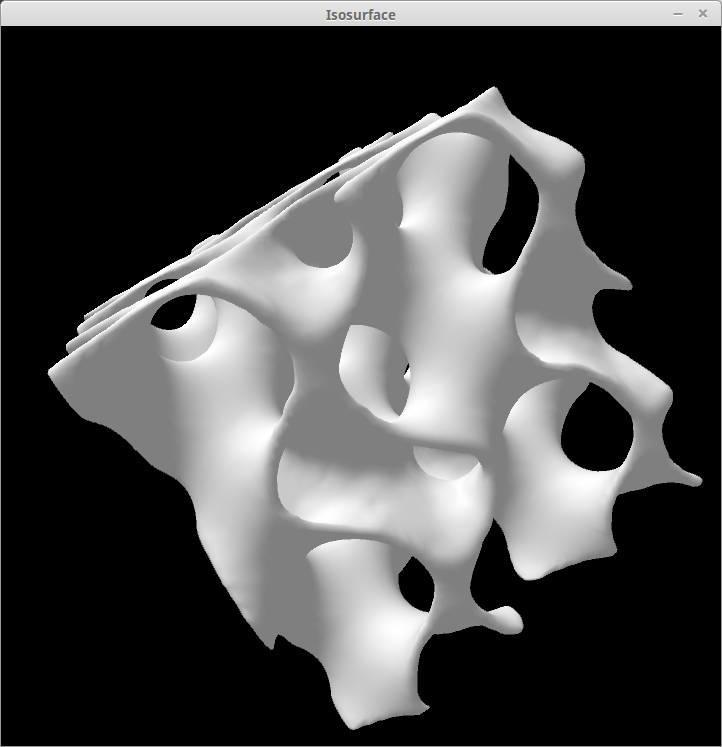
# This example implements a custom VolumetricSpace uMath.sing an implicit function
# to calculate each voxel. This is slower than the default array or HashMap
# based implementations, but also has much less memory requirements and so might
# be an interesting and more viable approach for very highres voxel spaces
# (e.g. >32 million voxels). This implementation here also demonstrates how to
# achieve an upper boundary on the iso value (in addition to the one given and
# acting as lower threshold when computing the iso surface)
#
# Usage:
# drag mouse to rotate camera
# mouse wheel zoom in/out
# l: apply laplacian mesh smooth
#
#

#
# Copyright (c) 2010 Karsten Schmidt & ruby-procesMath.sing version Martin Prout 2013
# This sketch relies on a custom ruby-procesMath.sing mesh_to_vbo library
#
# This library is free software you can redistribute it and/or
# modify it under the terms of the GNU Lesser General Public
# License as published by the Free Software Foundation either
# version 2.1 of the License, or (at your option) any later version.
#
# http://creativecommons.org/licenses/LGPL/2.1/
#
# This library is distributed in the hope that it will be useful,
# but WITHOUT ANY WARRANTY without even the implied warranty of
# MERCHANTABILITY or FITNESS FOR A PARTICULAR PURPOSE.  See the GNU
# Lesser General Public License for more details.
#
# You should have received a copy of the GNU Lesser General Public
# License along with this library if not, write to the Free Software
# Foundation, Inc., 51 Franklin St, Fifth Floor, Boston, MA  02110-1301  USA
#

require 'toxiclibs'

load_library :mesh_to_vbo

RES = 64
ISO = 0.2
MAX_ISO = 0.66

attr_reader :mesh, :vbo, :curr_zoom, :implicit

def setup
  size(720,720, P3D)
  Processing::ArcBall.init(self)
  @vbo = MeshToVBO.new(self)
  @curr_zoom = 1
  vol = EvaluatingVolume.new(TVec3D.new(400,400,400), RES, RES, RES, MAX_ISO)
  surface = Volume::HashIsoSurface.new(vol)
  @mesh = Toxi::WETriangleMesh.new
  surface.compute_surface_mesh(mesh, ISO)
  @is_wire_frame = false
  no_stroke
  @implicit = vbo.meshToVBO(mesh, true)
  implicit.setFill(color(222, 222, 222))
  implicit.setAmbient(color(50, 50, 50))
  implicit.setShininess(color(10, 10, 10))
  implicit.setSpecular(color(50, 50, 50))
end

def draw
  background(0)
  lights
  define_lights
  shape(implicit)
end

def key_pressed
  case key
  when 'l', 'L'
    Toxi::LaplacianSmooth.new.filter(mesh, 1)
    @implicit = vbo.meshToVBO(mesh, true)
    # new mesh so need to set finish
    implicit.setFill(color(222, 222, 222))
    implicit.setAmbient(color(50, 50, 50))
    implicit.setShininess(color(10, 10, 10))
    implicit.setSpecular(color(50, 50, 50))
  when 's', 'S'
    save_frame("implicit.png")
  end
end

def define_lights
  ambient_light(50, 50, 50)
  point_light(30, 30, 30, 200, -150, 0)
  directional_light(0, 30, 50, 1, 0, 0)
  spot_light(30, 30, 30, 0, 40, 200, 0, -0.5, -0.5, PI / 2, 2)
end

class EvaluatingVolume < Volume::VolumetricSpace

  attr_reader :upper_bound, :lut
  FREQ = Math::PI * 3.8

  def initialize(scal_vec, resX, resY, resZ, upper_limit)
    super(scal_vec, resX, resY, resZ)
    @upper_bound = upper_limit
  end

  def clear
    # nothing to do here
  end

  def getVoxelAt(i)
    getVoxel(i % resX, (i % sliceRes) / resX, i / sliceRes)
  end

  def getVoxel(x, y, z)  # can't overload so we renamed
    val = 0
    if (x > 0 && x < resX1 && y > 0 && y < resY1 && z > 0 && z < resZ1)
      xx = x * 1.0 / resX - 0.5  # NB: careful about integer division !!!
      yy = y * 1.0 / resY - 0.5
      zz = z * 1.0 / resZ - 0.5
      #val = Math.sin(xx * FREQ) + Math.cos(yy * FREQ) + Math.sin(zz * FREQ)
      val = Math.cos(xx * FREQ) * Math.sin(yy* FREQ) + Math.cos(yy* FREQ) * Math.sin(zz* FREQ) + Math.cos(zz* FREQ)* Math.sin(xx* FREQ)
      if (val > upper_bound)
        val = 0
      end
    end
    return val
  end
end
############################################
# mesh_to_vbo.rb
# a ruby library to convert toxi.mesh object
# to vbo (PShape) written by Martin Prout
############################################
class MeshToVBO
  PShape = Java::ProcessingCore::PShape
  attr_reader :parent

  def initialize(parent)
    @parent = parent
  end

  def meshToVBO(mesh, smth)
    retained = parent.create_shape
    retained.begin_shape(PShape::TRIANGLES)
    if smth
      mesh.compute_vertex_normals
      mesh.getFaces.each do |f|
        retained.normal(f.a.normal.x, f.a.normal.y, f.a.normal.z)
        retained.vertex(f.a.x, f.a.y, f.a.z)
        retained.normal(f.b.normal.x, f.b.normal.y, f.b.normal.z)
        retained.vertex(f.b.x, f.b.y, f.b.z)
        retained.normal(f.c.normal.x, f.c.normal.y, f.c.normal.z)
        retained.vertex(f.c.x, f.c.y, f.c.z)
      end
    else
      mesh.get_faces.each do |f|
        retained.normal(f.normal.x, f.normal.y, f.normal.z)
        retained.vertex(f.a.x, f.a.y, f.a.z)
        retained.vertex(f.b.x, f.b.y, f.b.z)
        retained.vertex(f.c.x, f.c.y, f.c.z)
      end
    end
    retained.end_shape
    retained
  end

  # variant
  # input array of meshes, output an array of shapes
  def meshToRetained(mesh, smth)
    mesh.map { |m| meshToVBO(m, smth) }
  end
end

# A ruby processing sketch (needs re-factoring for jruby_art)
#
#
# This example implements a custom VolumetricSpace using an implicit function
# to calculate each voxel. This is slower than the default array or HashMap
# based implementations, but also has much less memory requirements and so might
# be an interesting and more viable approach for very highres voxel spaces
# (e.g. >32 million voxels). This implementation here also demonstrates how to
# achieve an upper boundary on the iso value (in addition to the one given and
# acting as lower threshold when computing the iso surface)
#
# Usage:
# drag mouse to rotate camera
# w: toggle wireframe on/off
# mouse wheel to zoom in/out
# l: apply laplacian mesh smooth
#
#

#
# Copyright (c) 2010 Karsten Schmidt & ruby-processing version Martin Prout 2012
# This sketch relies on a custom toxiclibscore library for PovRAY export
#
# This library is free software you can redistribute it and/or
# modify it under the terms of the GNU Lesser General Public
# License as published by the Free Software Foundation either
# version 2.1 of the License, or (at your option) any later version.
#
# http://creativecommons.org/licenses/LGPL/2.1/
#
# This library is distributed in the hope that it will be useful,
# but WITHOUT ANY WARRANTY without even the implied warranty of
# MERCHANTABILITY or FITNESS FOR A PARTICULAR PURPOSE.  See the GNU
# Lesser General Public License for more details.
#
# You should have received a copy of the GNU Lesser General Public
# License along with this library if not, write to the Free Software
# Foundation, Inc., 51 Franklin St, Fifth Floor, Boston, MA  02110-1301  USA
#

require 'toxiclibs'
load_library 'vecmath' # uncomment this line for ruby-processing
RES = 64
ISO = 0.2
MAX_ISO = 0.66
attr_reader :mesh, :gfx, :curr_zoom, :is_wire_frame

def setup
  size(720, 720, P3D)
  ArcBall.init(self)
  @gfx = Gfx::ToxiclibsSupport.new(self)
  vol = EvaluatingVolume.new(Toxi::Vec3D.new(400, 400, 400), RES, RES, RES, MAX_ISO)
  surface = Volume::HashIsoSurface.new(vol)
  @mesh = Toxi::WETriangleMesh.new
  surface.compute_surface_mesh(mesh, ISO)
  @is_wire_frame = false
end

def draw
  background(0)
  if is_wire_frame
    no_fill
    stroke(255)
  else
    fill(255)
    no_stroke
    define_lights
    lights
  end
  @gfx.mesh(mesh, true)
end

def key_pressed
  case key
  when 'w', 'W'
    @is_wire_frame = !is_wire_frame
  when 'l', 'L'
    Toxi::LaplacianSmooth.new.filter(mesh, 1)
  when 's', 'S'
    save_frame('implicit.png')
  end
end

def define_lights
  ambient_light(50, 50, 50)
  point_light(30, 30, 30, 200, -150, 0)
  directional_light(0, 30, 50, 1, 0, 0)
  spot_light(30, 30, 30, 0, 40, 200, 0, -0.5, -0.5, PI / 2, 2)
end

# Creating a volumetric space class
#
class EvaluatingVolume < Volume::VolumetricSpace
  include Processing::Proxy
  attr_reader :upper_bound
  FREQ = PI * 3.8

  def initialize(scal_vec, resX, resY, resZ, upper_limit)
    super(scal_vec, resX, resY, resZ)
    @upper_bound = upper_limit
  end

  def clear
    # nothing to do here
  end

  def getVoxelAt(i)
    getVoxel(i % resX, (i % sliceRes) / resX, i / sliceRes)
  end

  def getVoxel(x, y, z)  # can't overload so we renamed
    val = 0
    if x > 0 && x < resX1 && y > 0 && y < resY1 && z > 0 && z < resZ1
      xx = x * 1.0 / resX - 0.5  # NB: careful about integer division !!!
      yy = y * 1.0 / resY - 0.5
      zz = z * 1.0 / resZ - 0.5
      val = cos(xx * FREQ) * sin(yy * FREQ) + cos(yy * FREQ) * sin(zz* FREQ) + cos(zz * FREQ) * sin(xx * FREQ)
      # val = sin(xx * FREQ) + cos(yy * FREQ) + sin(zz * FREQ)
      # val = sin(xx * FREQ) * (xx * FREQ) + sin(yy * FREQ) * (yy * FREQ) + sin(zz * FREQ) * (zz * FREQ)
      val = 0 if val > upper_bound
    end
    val
  end
end